Pier & Beam Foundations vs. Slab Foundations: Which is Right for Your Project?
Choosing Between Pier & Beam and Slab Foundations
The foundation you choose sets the stage for every square foot of your commercial or industrial build. Get it right, and you gain decades of stable performance. Get it wrong, and you invite costly repairs, downtime, and structural headaches down the road.
For facility managers, developers, and contractors across Texas and Louisiana, the decision often comes down to two options: pier and beam foundations versus slab foundations. This guide breaks down how each system works, where each one shines, and what to weigh before you commit.
Understanding Foundation Types
Every building rest on one core system that transfers its weight to the ground below. That system is the foundation, and the two most common foundation types for commercial and industrial work are pier and beam and slab-on-grade.
The Gulf States present unique challenges. Expansive clay soils, high water tables, and heavy seasonal rains all affect how a foundation behaves over time. In Texas and Louisiana, these conditions make your foundation choice a strategic decision, not a formality.
What Are Pier and Beam Foundations
Pier and beam foundations raise a structure above the ground using a network of concrete piers and horizontal beams. The piers extend down to stable soil or bedrock, while the beams span between them to support the floor system above.
This design creates a crawl space between the ground and the building. That gap gives crews direct access to plumbing, electrical lines, and mechanical systems, which simplifies maintenance and future upgrades.
Key benefits of pier and beam foundations include:
- Utility access: Repairs and retrofits happen without breaking through concrete.
- Movement tolerance: The elevated design handles shifting soils better in many cases.
- Flood resilience: Raised structures reduce water intrusion during heavy rain events.
What Are Slab Foundations
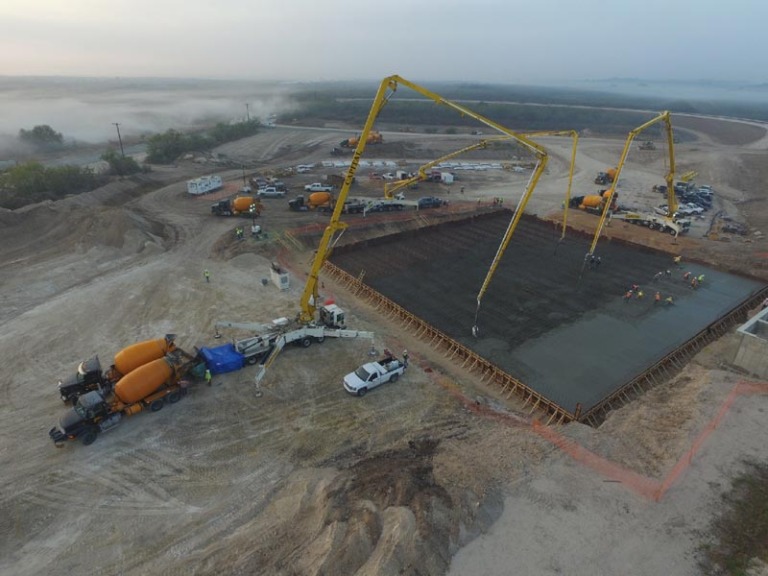
Slab foundations, often called slab-on-grade, consist of a single thick layer of poured concrete that rests directly on prepared ground. Steel reinforcement and post-tension cables add strength, allowing the slab to bear substantial weight.
This system is a workhorse for warehouses, distribution centers, manufacturing plants, and other industrial facilities that demand a flat, durable, load-bearing surface. The concrete cures into a solid base ready for heavy equipment and constant traffic.
Advantages of slab foundations include:
- Load capacity: Thick, reinforced concrete supports heavy machinery and inventory.
- Lower maintenance: No crawl space means fewer accessible components to service.
- Faster installation: A single pour often speeds up the construction timeline.
Pier and Beam Foundations vs. Slab Foundations
Both systems present distinct advantages and limitations. The optimal choice among pier, beam, and slab foundations depends on site conditions, budget constraints, and the building’s functional requirements.
Utility access: Pier and beam foundations offer excellent access to plumbing, electrical, and mechanical systems. Slab foundations, on the other hand, provide limited access, often requiring cutting into the concrete for repairs.
Load capacity: Both systems handle heavy loads well. Pier and beam foundations offer strong load-bearing capabilities, while slab-on-grade foundations provide very strong support, making them ideal for heavy machinery and equipment.
Flood resistance: Pier and beam foundations offer greater flood resistance, elevating the structure above ground level. Slab foundations sit closer to grade, making them more vulnerable to water damage.
Installation speed: Slab foundations are faster to install, typically requiring a single pour. Pier and beam systems involve more labor and time to complete.
Maintenance access: Pier and beam foundations allow for easy maintenance access beneath the structure. Slab foundations require cutting into the concrete to access utilities, making repairs more costly and time-consuming.
Factors to Consider When Choosing the Right Foundation Type
Choosing the right foundation type means balancing several variables at once. Rushing this stage often leads to expensive corrections later. Weigh these factors before you break ground:
- Soil composition: Test for clay content, load-bearing capacity, and moisture behavior.
- Water table and drainage: High groundwater favors elevated designs and strong drainage plans.
- Building load: Heavy machinery and dense storage point toward reinforced slabs.
- Budget and timeline: Slabs often cost less and install faster; pier and beam offer long-term access value.
- Future flexibility: Plan for expansions, equipment changes, and utility upgrades.
- Local codes: Texas and Louisiana jurisdictions carry specific flood and structural requirements.
FAQs
How Does Foundation Choice Affect Resale Value?
A well-built, maintained foundation signals structural integrity to future buyers. Documented soil testing, quality concrete work, and a maintenance history strengthen market position and support higher valuations.
Are Pier and Beam Foundations More Energy Efficient Than Slab Foundations?
It depends. Pier and beam crawl spaces allow for insulation and air circulation, while slab foundations offer thermal mass that regulates interior temperatures. Climate, insulation, and building design all influence the efficiency edge.
What Role Does Drainage Play in Foundation Performance?
Drainage is critical. Poor water management causes soil movement, erosion, and foundation pressure. Proper grading, gutters, and subsurface drainage protect both foundation types from heavy Gulf States rainfall.
How Often Should Foundations Be Professionally Inspected?
Schedule an inspection at least once every two to three years, and sooner after major storms or noticeable changes. Facilities with heavy equipment benefit from more frequent checks.
What Signs Indicate That a Foundation May Need Repair or Stabilization?
Watch for cracks in walls or floors, uneven surfaces, sticking doors, gaps around windows, and pooling water near the structure. Any of these warrants prompt professional evaluation.
Partner With Ashton Sawing and Drilling for Your Next Foundation Project
The right foundation deserves the right concrete partner. For more than 25 years, Ashton Sawing and Drilling have served commercial and industrial clients across Texas, Louisiana, and the Gulf States with precision and speed.
With multiple offices, new equipment, and quick turnarounds, we take on projects of every size. Contact Ashton Sawing and Drilling today for a free estimate and put two decades of Gulf States expertise to work.